Theresa May, Victoria Atkins and Cannabis Conflict: A BBC FOI Tribunal Investigation
An FOI and tribunal-based investigation into BBC disclosure, cannabis policy, and public interest concerns.

On 18 March 2026 HM Courts & Tribunal Service acknowledged receipt of an appeal against a tribunal ruling.
The ruling itself centred around whether the BBC were asked to stop reporting on potential conflicts of interest surrounding Theresa May and Victoria Atkins and cannabis, prior to the legalisation of medicinal cannabis use under prescription.
A Freedom of Information (FOI) request was submitted in 2024, asking for government communications that mentioned May, Atkins, or cannabis.
The BBC responded stating that any information, if held, would relate to journalism and was exempt.
They refused a route to Internal Review and suggested that I should contact the Information Commissioners Office (ICO) if I wasn't happy.
I did so, citing Sugar v BBC [2012] UKSC 4, a case which established that information held to any significant degree for the purposes of journalism falls outside the scope of FOIA.
The issue, therefore, is not whether the journalism derogation exists — but whether it has been correctly applied. In other words, whether any information held is genuinely journalistic in nature, or whether it may also be held for other purposes, such as administrative or legal functions.
Unfortunately, the ICO sided with the BBC. They did not require the BBC to verify whether information was held, let alone whether it might be held for purposes outside of journalism.
I was then directed to tribunal, and that ruling is now being challenged on appeal
In that process, an issue arose which called into question the consistency of the ICO’s approach.
I was engaged in a separate Subject Access Request (SAR) dispute, where I was required to verify the nature of the information I held on an individual I had reported on. This involved providing emails, articles, and clearly distinguishing between personal data and records of comments made in the public domain.
The ICO’s final decision in that matter, along with the evidence bundle submitted to the tribunal, demonstrates the level of scrutiny I was subject to.
By contrast, the ICO did not appear to apply those same standards to the BBC in this case.
This concern regarding consistency of process was raised with the tribunal a week prior to the hearing.
The ICO responded only minutes before proceedings began.
The ICO, who did not attend the hearing, submitted that the Tribunal was not the appropriate forum to consider concerns regarding the conduct of their investigation, asserting that such matters fell outside its jurisdiction.
They further indicated that they would be likely to appeal any decision that sought to address issues of consistency.
That, in itself, raises concern. While the Tribunal may not be the appropriate forum for such matters, the fact that the issue has been raised at all is significant, given the ICO’s role in ensuring fair and reasonable access to information.
Interestingly, also prior to the tribunal, the BBC provided a narrowed response to the original request, indicating that they had limited the scope of their search.
They followed this by stating that no information was identified, and sought to characterise the proceedings as “academic”.
I responded to both the BBC and the Tribunal, highlighting that the narrowed search appeared incomplete, and that it was for the Tribunal—not the respondent—to determine whether the case could be considered academic.

I therefore remain none the wiser as to whether information exists within the scope of my original request.
However, what I can show is that concerns regarding consistency of process were firmly resisted when raised with the Tribunal, and that the BBC conducted a limited search only after relying on a position that such a search was not required due to the journalism derogation — a position the ICO supported.
I can also point to a ruling which, in my view, departs from established precedent, hence the appeal.
But here is the key point: the public interest surrounding the potential conflicts of May and Atkins is now on official record.
That, in itself, is a step forward — and has to be viewed as such by those who have raised concerns over the years.
I personally felt this would be a win, regardless of what the ultimate ruling was.
But there are concerns with the final ruling, and if the appeal is accepted, it is that public interest — and the questions it raises — that may ultimately determine whether the journalism derogation has been applied appropriately.
In particular, whether any information held is genuinely journalistic in nature, or whether it may fall outside that scope and therefore require disclosure.
Of all the things I’ve worked on, the question of why reporting on the potential conflicts involving May and Atkins disappeared is the longest-running line of enquiry
It remains part of public discourse. It is not uncommon to see responses to police reports of cannabis-related offences that reference perceived inconsistencies, often framed along the lines of: “So it’s acceptable for some, but not for others?”
The wording varies, and people debate the details, but the underlying point is consistent: concerns about conflict were reported, and yet no public enquiry followed.
That absence of scrutiny — particularly given the scale of the concerns raised at the time — is difficult to ignore
The fact that there wasn’t — and that reporting on the issue ceased without follow-up — suggests… well, you tell me what it suggests.
It was around February 2019 that I began asking why there had been no follow-up. This coincided with the announcement of the 63rd UN-CND, where the rescheduling of cannabis and CBD products was under consideration.
This raised a further question: whether May and Atkins had any role in shaping the UK’s position at that meeting.
The meeting itself was scheduled to take place that year but was ultimately postponed until December 2020.
At the time, there were parallel developments within the hemp and CBD sector that drew my attention to this area more closely. The introduction of novel food requirements was followed by an industry meeting in Brussels, where the focus appeared to centre on demonstrating historic sales, rather than evidence of consumption.
During the same period, the World Health Organisation published recommendations on the reclassification of cannabis, with a particular focus on CBD. This coincided with the emergence of Epidiolex within a rapidly evolving regulatory landscape, and a lack of follow-up scrutiny in relation to previously reported conflict concerns.
Taken together, these developments raised questions as to whether policy direction, regulatory treatment, and public narrative were aligning in a way that had not been fully examined.
So in May 2020, I submitted an FOI request seeking any records of policy input by May and Atkins in relation to the 63rd UN-CND.
Subsequent correspondence from the Home Office confirmed that information within the scope of that request is held, but has been withheld on the basis that it relates to the formulation of government policy and international relations.
My concern was this: Potential conflicts were publicly reported, yet the scrutiny surrounding them fell away. When those same individuals later occupied positions where those conflicts arguably became more relevant, there was no renewed attention, no follow-up, and no clear accountability.
Since then, a number of investigative routes have been pursued to address a central question: whether reporting on a matter of public interest was, in effect, curtailed.
The BBC was not the only organisation approached. A similar FOI request was submitted to Channel 4, which had also reported on the issue at the time.
They too relied on the journalism derogation, without confirming whether information was held beyond that scope.
One obvious line of enquiry examined Theresa May’s wider connection to cannabis policy, including links to GW Pharmaceuticals and academic institutions, including the University of Reading.
The relevance of the latter becomes clearer when considering the extent of academic involvement in cannabinoid research. Reading, in particular, played a role in the development of Epidiolex.
The University of Aberdeen is also relevant in this context. However, in 2014, May appointed Professor Ben Whalley to the Advisory Council on the Misuse of Drugs (ACMD).
Whalley had links to both Reading and GW Pharmaceuticals, and was involved in research connected to the development of Epidiolex, and later chaired the Phytocannabinoid Working Group, which contributed to the definition of 12 controlled cannabinoids in 2016.

The issue is whether conflicts were properly declared and recorded.
Professor Whalley has stated that he declared conflicts. However, according to an FOI response from the ACMD, those declarations appear to refer only to “sponsors”, without identifying who those sponsors were.
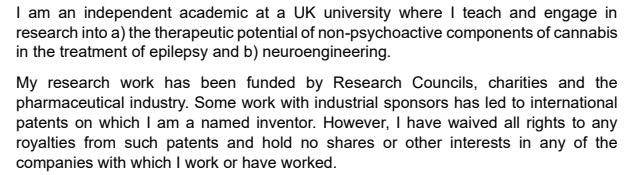
That distinction matters.
Those sponsors include Otsuka Pharmaceuticals, which collaborated with GW Pharmaceuticals through R&D funding for Reading from 2007.
Two patents were registered prior to his appointment at the ACMD, and both are connected to those sponsors.
By extension, placing him on the Phytocannabinoid Working Group made those patents relevant, regardless of whether royalties were waived, as did the identification of all associated sponsors.
An Internal Review was requested to seek clarification on whether those sponsors were documented in full. That request was refused, and the matter is now subject to investigation by the ICO.
Furthermore, there remain outstanding questions surrounding Reading University’s role in this timeline. These include a visit by Theresa May in 2013, prior to Whalley’s appointment to the ACMD, and previously published material indicating that Whalley and his team were directly supported in research in 2012.
Some of that material is no longer publicly accessible via the University’s website, which raises further questions as to how these links have been recorded and maintained.
Taken together, these points reinforce the need to determine whether the “sponsors” referenced in conflict declarations were fully identified and documented.

If those sponsors were not specifically identified, it would reinforce a wider community concern: that Professor Whalley’s position may have influenced policy development in ways that aligned with the interests of GW Pharmaceuticals
That concern is heightened by changes to publicly available material from Reading University relating to the period leading up to Whalley’s appointment, including references to his research activity and the circumstances surrounding that appointment.
Beyond Whalley’s appointment to the ACMD, Theresa May’s timeline intersects with a number of significant cannabis-related developments.
The Home Office provided GW Pharmaceuticals with samples of seized cannabis on four known occasions: 2004, 2008, 2014, and 2018.
May can also be seen commenting on cannabis in Parliament in 2007, referencing cross-party support for reclassification to a Class B drug.
Those events have been covered in previous articles from The Hemp Hound Agency.
She then served as Home Secretary between 2010 and 2016, before becoming Prime Minister, during which time she was associated with the politically managed process that led to the legalisation of medicinal cannabis use in 2018.
And to be specific, she was identified as the driver of the policy vehicle by one of the mothers of a child that is associated with the campaign to legalise medicinal cannabis. The campaign focused on Epidiolex, manufactured by a company that is on record as having advised the Home Office, provided background for parliamentary responses, and maintained a consistent narrative in relation to cannabis policy.

So if she is 'the driver', there is a clear problem, and that's before we even look at her husband.
As Home Secretary she presided over the Home Office on one occasion where there was a transfer of seized cannabis for analysis. As PM whilst being 'the driver', there's a distinct likelihood that she would have been aware of the transfer in 2018.
That would suggest:
She presided over licensing
She appointed a GW affiliated academic on the ACMD
She presided over one, possibly two transfers of seized cannabis (2014, 2018)
Due to her early bi-partisan signalling, it's possible she knew of the transfer in 2008
If she was aware of those transfers, it raises the possibility that she would also have been aware that seized cannabis was being supplied for academic research, including work examining cannabinoid composition and characteristics
Those transfers occurred whilst the Home Office maintained that cannabis had no medicinal potential
She then oversaw a legislative process that ultimately led to commercial avenues opening for a company with which the Home Office had an established relationship
And she would have presided over the Home Office during the creation of CBD Policy, which was developed at the time British Sugar were applying for a license to grow cannabis for GW Pharmaceuticals specifically for the creation of Epidiolex
Taken together, this places her in proximity to a number of key developments in cannabis policy over an extended period, a number of which are described further in the article.
The question, therefore, is not whether she was involved — but at what point that involvement became decisive.
Was it in 2007 when she can be seen signalling cross-party support for reclassifying cannabis?
Was it from 2010 from the point she became Home Secretary?
Was it from the point at which CBD policy began to take shape around 2015?
Or was it from 2018 when the campaign to legalise medicinal access emerged?
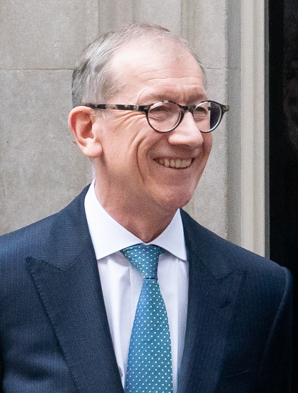
Many people who question Theresa May’s potential conflicts focus directly on her husband, Philip.
However, focusing solely on Philip risks overlooking other, more structurally significant connections.
One such point of interest is the appointment of Professor Ben Whalley to the ACMD in 2014.
While it is recognised that Whalley had links to GW Pharmaceuticals, those connections were not clearly articulated at the point of appointment.
What is less widely discussed is that the appointment itself was made by Theresa May.
That naturally leads to consideration of the wider context. For example, May’s visit to the University of Reading coincided with a period in which GW Pharmaceuticals expanded its cannabinoid research focus, from seven cannabinoids in 2012 to fifteen by 2013.

Given the Home Office’s role in licensing and oversight, senior officials, including the Home Secretary, would likely have had awareness of key industry actors and their academic partnerships.
Whalley has stated to me directly that he had never met May, yet was appointed to the ACMD and subsequently served on the Phytocannabinoid Working Group during her tenure.
The question that follows is not whether that appointment occurred, but how it was informed — and who, if anyone, recommended his inclusion.
Furthermore, when defining 12 controlled cannabinoids in 2016, why didn't Whalley's recommendations list conflicts?
When considered against the timing of the appointment, the lack of declared conflicts, and with the backdrop of the creation of CBD Policy, there are visible tensions there that are hard not to notice.
The other obvious line of enquiry examined Victoria Atkins’ trajectory, and how it intersects with that of Theresa May
Atkins’ parliamentary career began in 2015, the same year her husband applied for a Home Office licence for British Sugar to cultivate cannabis for GW Pharmaceuticals, specifically for the production of Epidiolex.
That licence was granted in 2016.
In 2017, she was appointed Minister for Safeguarding by Theresa May, a role which included oversight of drug policy. Before that appointment Atkins declared in an open session that she had a conflict of interest when discussing cannabis, due to her husband’s role.
Interestingly, Atkins declared that British Sugar had donated £1,120 for accommodation for her and her husband, the then Managing Director of British Sugar, for attending the 2017 Conservative Party Conference, which was held weeks before she was given authority over drugs.

Her position meant that she was in sight of CBD Policy, as well as surrounding policy on cannabis, and as such had the potential to intersect with her husband’s interests, either through access to information or proximity to policy under development, or by considering her husband's interests when in sight of policy she could potentially influence.
In 2018, following press coverage of spousal connections, a video emerged of Atkins recusing herself from discussions on cannabis in open session due to a perceived conflict arising from her husband’s position.

Former MP Ronnie Cowan shared that video, which led me to contact him to request permission to use it in an article, and to ask why no public enquiry had followed.
He relayed that the Home Office had relied on Atkins’ 2017 declaration. However, no comparable explanation has been identified in relation to Theresa May, who appointed Atkins to that role.

Over the years, some have suggested that one of May or Atkins is ‘worse’ than the other
This article does not seek to portray either as a villain. Instead, it focuses on the wider context surrounding the concerns reported in 2018, asking why no enquiry followed, and whether reporting on those concerns was curtailed.
Both figures have taken different paths, but there are notable overlaps.
Theresa May became an MP in May 1997 — the same period in which Home Office records show that discussions around medical cannabis policy were underway.

That, in itself, does not demonstrate anything conclusive. However, by 2007 she can be seen offering cross-party support for the reclassification of cannabis while serving in a senior opposition role.
What it does indicate is that cannabis policy was an area in which political alignment, rather than division, was already present, and that she was positioned to communicate on that issue at a national level.
A similar pattern of proximity can be observed in the case of Victoria Atkins.
She entered Parliament in 2015, the same year her husband was engaging with the Home Office and GW Pharmaceuticals in relation to a licence for British Sugar to cultivate cannabis.
Within a year, she was participating in parliamentary discussions on cannabis while declaring a conflict of interest. By the following year, she was recusing herself from such discussions, despite holding a ministerial role that included oversight of drug policy.
It is perhaps this visibility — the declaration, the recusal, and the timing — that has led some to view Atkins as more directly connected to the issue.
However, that perspective can narrow the field of view.
To me, both May’s and Atkins’ paths highlighted what I think is the biggest conflict... the dinner conversation.
During her time as Home Secretary and later as Prime Minister, Theresa May was married to Philip May, who worked as a relationship manager at Capital Group, a firm which held a significant stake in GW Pharmaceuticals. His role involved maintaining relationships with clients, which included companies such as GW.
At the same time, GW Pharmaceuticals had an established relationship with the Home Office, including the provision of seized cannabis for research purposes. Professor Geoffrey Guy, co-founder of GW, has stated that he was involved in shaping responses to parliamentary questions relating to cannabis.
It is also noted that, upon May’s appointment as Prime Minister, Capital Group stated that Philip May did not hold a direct financial or property portfolio.
Taken together, these factors raise questions about how such overlapping roles are perceived, particularly where public authority and commercial interests intersect.

A similar dynamic can be observed in the case of Victoria Atkins, whose husband’s role in a company licensed to cultivate cannabis for GW Pharmaceuticals intersected with her own responsibilities relating to drug policy.
To be clear, this is not to suggest that information was shared over the dinner table, or that any rules were breached. However, the existence of publicly reported concerns in both cases highlights why these relationships warrant scrutiny.
With that in mind, I submitted an FOI request to the Cabinet Office in 2021, asking whether any complaints had been made regarding the potential conflicts that had been reported.
And I use the term “potential” deliberately. While I, and others, can identify what appear to be conflicts, it is for competent authorities to determine whether those concerns meet the threshold set out in the Nolan Principles — the seven principles of public life.
The Cabinet Office response neither confirmed nor denied whether such complaints had been received, while acknowledging that there was a public interest in the concerns raised.
That alone is notable. However, what is equally notable is that any such complaints would fall to be considered under the Ministerial Code, which incorporates the Nolan Principles.
In practice, the Code is not enforced as a legally binding mechanism, and the decision as to whether an investigation proceeds ultimately rests with the sitting Prime Minister.
That returns to the earlier point: a limited explanation was provided in relation to Atkins’ 2016 declaration, yet no comparable response has been identified in relation to the concerns reported about May.
Taken together, these factors led me to submit FOI requests to both the BBC and Channel 4, asking whether any communication had taken place between the government and broadcasters regarding the reporting of those concerns.
There is simply too much surrounding context to ignore the question of why reporting on these issues fell away
Much of that context relates to regulatory development. It is also why I initially sought to determine whether any records existed showing May and Atkins having influence over the UK’s position at the 63rd UN-CND.
The refusal of that request, on the basis of potential prejudice to relations with foreign states, raises its own questions.
At the same time, the sequence of events is notable. The UN-CND announcement followed the EU authorisation of Epidiolex, which itself came after the UK legalised medicinal cannabis use, following a high-profile campaign centred on that same product.
This, in turn, followed its prior approval in the United States.
The regulatory treatment of the wider hemp and CBD sector developed alongside these events. This included the application of drug legislation to whole-plant products, and the use of Epidiolex-related toxicology data in shaping safety assessments for consumer CBD products.
There were also a number of parallel developments during this period:
In 2014 the Home Office stopped publishing FOI responses to questions regarding cannabis.
The Ministry of Justice has confirmed through FOI that they had authority over FOI policy at the time, and that there are records that have "Cannabis FOI Policy", and "Cannabis FOI Guidance" from 2014 to 2015.
CBD Policy was developed at the time.
The Home Office contacted the FSA to confirm the novel status of CBD in 2015.
In 2016, the MHRA moved to define CBD as a medicine, shortly after Epidiolex had passed Phase III trials. That position was later reversed following public backlash.
The Department for Business, Energy, and Industrial Strategy (BEIS) was created in 2016, shortly after May became Prime Minister. Its role would go on to intersect with areas relevant to cannabinoid policy, including industry development and regulatory positioning.
In 2017, the Home Office applied pressure to the FSA to define all cannabinoids as novel foods.
At the same time, the FSA maintained that whole-plant CBD products were non-novel, before subsequently working with EU member states to define CBD as a novel food from April 2018.
From that point, CBD policy expanded across multiple bodies, including the MHRA, FSA, and BEIS.
In July 2018, consumer CBD products were brought within the scope of the Misuse of Drugs Regulations 2001, during the same period as the public campaign that led to the legalisation of medicinal cannabis use later that year.
Restrictions on pet products also emerged in 2018, during a period in which GW Pharmaceuticals had announced developments in that area alongside ongoing research activity.
Finally, the formal move toward CBD novel foods in January 2019 coincided with the EU authorisation of Epidiolex (Epidyolex), marking a significant shift in the regulatory landscape for the wider hemp and CBD sector.
This raises the question of what might have emerged had an enquiry taken place during that period.
And given the information presented in this article, there is sufficient surrounding context to justify asking whether reporting on these issues may have been curtailed prior to the legalisation of medicinal cannabis use.
The volume and timing of regulatory developments alone raise legitimate questions as to whether scrutiny of potential conflicts could have disrupted or delayed those processes.
However, whether the BBC or other broadcasters hold information indicating that any such request was made remains unknown.
What can be shown is that, prior to the tribunal, the BBC conducted a narrowed search, having initially maintained that such a search was not required due to the journalism derogation. They then reported that no information was identified, and characterised the proceedings as “academic”.
That sequence of events raises its own questions, particularly in light of the ICO’s position.
But regardless of outcome, the public concern surrounding Theresa May and Victoria Atkins is now part of the official record.
It has neither been accepted nor dismissed. It is recorded neutrally as a concern raised and evidenced within a legal process, with the Cabinet Office FOI response submitted as evidence which neither confirms nor denies that they received complaints regarding the potential conflicts of May and Atkins, but does recognise the need for transparency over the matter.
I hope the Upper Tribunal recognises that point, upholds Sugar v ICO, and clarifies that public authorities — and those subject to the Act — must properly establish whether information is held, and whether it is genuinely covered by the journalism derogation.
In practical terms, that would require confirmation of two things:
a) whether relevant information is held, and
b) whether any such information is solely held for journalistic purposes.
If information is held within scope of the request, and is not strictly covered by the derogation — particularly if it relates to any request to curtail reporting on matters of public interest — then a wider set of questions would naturally follow:
Should the Freedom of Information framework be revisited to ensure that information is not unduly withheld where clear public interest concerns exist?
Should the ICO take steps to ensure consistency of approach across cases, regardless of whether the party involved is a major broadcaster or an independent applicant?
And, in light of the concerns already on record, is there now a basis for a formal enquiry into both the potential conflicts themselves and how those concerns were handled?
Until those questions are resolved — both whether relevant information exists, and why the underlying concerns were never fully examined — the matter cannot reasonably be treated as closed.
Final thought from The Hemp Hound Agency
If it ultimately transpires that the BBC holds no information within the scope of this request, that outcome would raise its own question: what was the purpose of the time spent pursuing this line of enquiry?
However, even in that scenario, the process has not been without value. The information obtained through related requests and investigations has further clarified the surrounding context, and in doing so, has reinforced the case for a more comprehensive examination of the issues raised.
For more information about The Hemp Hound Agency, contact: cefyn.jones@hemphound.co.uk




Comments