SPS Agreement UK EU: What It Means for CBD Novel Foods
The proposed SPS agreement between the UK and EU could fundamentally reshape how CBD and novel foods are regulated.

On 12 March 2026 The Hemp Hound Agency received a letter from the Food Standards Agency (FSA) which has serious implications for the UK hemp and CBD industry.
The letter states the following:
The UK is looking to enter a Sanitary and Phytosanitary Agreement (SPS) with the EU.
This would effectively place UK food safety regulation under EU legislative alignment.
This would include authority over Novel Foods.
The negotiations are being led by UK Government rather than the FSA.
What the FSA has said about this is the following:
They intend to continue processing novel food applications currently in the system, prioritising those closest to completion.
They cannot confirm that applications will reach ministerial decision before any SPS agreement is implemented.
Applicants are being advised to consider applying to the EU authorisation system.
The implications of this development are significant
It suggests that the FSA is at a point where it can no longer meaningfully control the outcome of the CBD novel foods process.
For six years the UK has operated a domestic CBD authorisation pathway, yet the prospect of SPS alignment now raises the possibility that many of those applications may never reach ministerial decision.
Despite the FSA’s assurance that assessments will continue, it is difficult to see how any applications could progress much further.
Furthermore, authorisations ultimately require ministerial approval, and it is those same ministers who are currently negotiating the SPS agreement rather than the FSA.
Other Novel Foods and Novel Food Applications will be affected
This situation does not only affect the CBD industry. If the UK ultimately aligns with EU SPS rules in the manner currently proposed, existing UK authorisations could become redundant once EU authorisations apply across Great Britain.
However, the implications for the CBD industry are likely to be more severe:
The EU has effectively paused its CBD novel foods process due to unresolved data gaps, many of which relate more closely to pharmaceutical-style toxicology than traditional food safety questions.
If the UK’s provisional 10 mg ADI appears restrictive, the EU’s recent discussions around a 2 mg ADI highlight just how uncertain the regulatory landscape for CBD products may become.
It is also worth remembering that even though the FSA’s 2018 Article 4 submission helped initiate CBD Novel Foods, the document ultimately published by the EU was heavily edited, resulting in CBD being treated as a novel food regardless of extract dynamics.
Where does this leave CBD companies?
Regardless of whether an application is close to ministerial sign-off or still in earlier stages, I advise that companies seek independent regulatory advice.
I cannot in good faith recommend that companies rely on the trade associations in this matter.
Companies considering submissions to the EU system may wish to seek guidance from specialists such as The Canna-Consultants / Advanced Food Regulation, who have experience navigating complex novel food authorisations.
Companies may also wish to seek legal advice, and firms such as Legal Products Group are well placed to assist in understanding the regulatory implications of the current situation.
Situation Analysis
Before going any further, it’s worth saying that this situation is not entirely doom and gloom.
At first glance it may appear that CBD policy in the UK is effectively coming to an end, only to be replaced by CBD policy shaped at EU level.
Some people may view that as a victory for me, given that I have been challenging the direction of CBD policy long before I knew its name. But as the saying goes, better the devil you know.
As a one-man band it has been a difficult task engaging with the FSA as much as I have. The EU was always the next frontier in that conversation, but that step depended on first seeing how the UK system would develop.
If CBD policy simply fades into irrelevance, that leaves very little to work with. Except for one rather interesting detail.
The FSA update appears to have been sent to companies with novel food applications. Yet I received one too — despite not having a novel food application in the system.
What I do have, however, is an Article 4 submission relating to whole-plant products, and that makes the current situation all the more interesting.
This is where I need to put a more personal hat on to explain how this affects me, the companies involved in my Article 4 submission, and why I believe this may represent a nugget in the rough that could secure whole-plant products in the UK
It seems that the FSA is in a really sticky situation:
They may ultimately have to demonstrate that they continued processing novel food applications between now and the point at which the UK might enter into an SPS agreement.
If such questions are asked, they may arise in the context of scrutiny or potential legal challenge.
With the possibility that the 15 companies currently progressing through the system may never receive ministerial sign-off, further questions from industry appear inevitable.
The regulatory framework [cartel market] built around the 10 mg ADI will disappear.
And if the SPS agreement ultimately proceeds, CBD policy as it has existed since around 2014–15 may end without ever fully delivering any outcomes it was designed to achieve.
From my perspective, that final point may ultimately prove more problematic for the FSA than the others.
So how does the FSA demonstrate that it has achieved something during the six years it has overseen domestic food safety in this area?
One obvious possibility would be to consider processing my Article 4 submission before any SPS agreement with the EU is concluded.
The update appears to have been sent to companies progressing through the novel foods process. Yet I received one too — despite not having a novel food application in the system.
Article 4 determinations sit in a different position. The FSA can rule on an Article 4 without necessarily deferring to the EU, whereas full novel food authorisations could ultimately fall under EU authority if the SPS agreement proceeds.
Of course, the FSA could still choose to defer the Article 4. If that were to happen, CBD policy — which has effectively shaped the sector since around 2014 — would have little to show for the time, effort and resources invested in it.
Unless, of course, the intention of that policy was to diminish the authenticity of whole-plant products. In that case it would have been remarkably successful.
But I think there is more to CBD Policy, and that observation comes from the person who identified it as the driving force behind CBD Novel Foods.
I do have to be careful here
The FSA gave me that update for a reason.
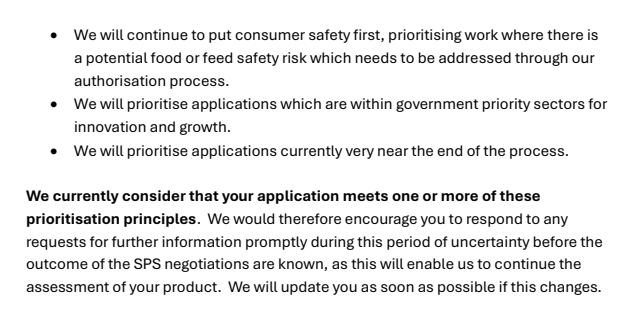
Based on the information provided in the letter, it would appear that I fall within at least one of the prioritisation categories.
While my Article 4 submission is not part of the novel foods authorisation process, it may nonetheless intersect with the government’s stated interest in innovation and growth within emerging sectors.
The middle point is therefore particularly interesting.
Policy is rarely constructed around industries that government intends simply to encourage. Policy tends to emerge where the state believes oversight or control is required.
This raises a broader question: if the UK ultimately aligns with EU SPS rules, would the government retain any meaningful ability to influence innovation and growth within the domestic CBD sector?
My own view is that it would not, unless...
What if the FSA were to process my Article 4 prior to the UK signing any SPS agreement?
It might go a long way towards repairing industry trust in the regulator.
That alone could help mitigate any reputational damage that may arise should the EU ultimately assume control over novel food authorisations.
A determination on whole-plant products derived from traditional, unselective processes could provide a level of regulatory clarity for the UK market at a time when the novel foods pathway appears increasingly uncertain.
With that in mind, it seems reasonable that the FSA might be more inclined to consider progressing such a determination if it were clear that the issue is of genuine interest to the wider industry.
That does not necessarily mean companies should join the Article 4 submission itself — although they are free to do so simply by becoming members of The Hemp Hound Agency.
However, ensuring that the FSA understands that the issue is of interest to the sector may help ensure that it receives the consideration it deserves.
There is a fundamental problem with CBD Novel Foods
Much of the industry has spent years attempting to navigate the authorisation process without first examining the regulatory history that led to CBD being treated as a novel food in the first place.
The concern raised by regulators was not the existence of CBD in food. Rather, it centred on compound concentrations exceeding those found in the source material, and on highly selective extraction processes.
In other words, the regulatory concern focused on altered extract dynamics — not traditional whole-plant preparations. Indeed, the FSA itself acknowledged in 2017 that whole-plant products were not considered novel.
That position can of course be questioned given how CBD novel foods has since been managed in both the UK and the EU. However, the regulatory documents themselves confirm that this distinction once existed.
Which brings us to the obvious question: how do we demonstrate to the FSA that an Article 4 determination for whole-plant products — derived through unselective processes and remaining within the strength of the source material — is worth considering?
It is also worth noting that, as I understand it, Article 4 determinations do not require ministerial sign-off in the same way as novel food authorisations.
This is ultimately an industry concern
The Hemp Hound Agency cannot resolve the novel foods situation itself. However, I may be able to help the industry if it were prepared to support the Article 4 submission relating to whole-plant products.
At the same time, progressing that Article 4 could also serve the interests of the FSA. A determination on whole-plant products would allow CBD policy to demonstrate that it has delivered at least some regulatory clarity during the period in which the UK has had control over domestic food safety.
Even if the EU were not to recognise such a determination in the future, whole-plant products in the UK would still benefit from a clearer regulatory position.
In doing so, the FSA could also preserve a degree of credibility in how this complex regulatory process has unfolded.
For more information about the FSA SPS update, the Article 4 for whole-plant products, or if you'd like to say hello, email: cefyn.jones@hemphound.co.uk


Comments