Pureis: The FSA Scandal Hiding in Plain Sight
How Pureis Became the Clearest Test of Whether the UK CBD Novel Foods Process Was Applied Equally

Over the past four years, a single question has been raised repeatedly in the UK hemp and CBD industry, specifically in regard to CBD novel foods:
How did certain CBD products, including those linked to Pureis, come to be included on the Food Standards Agency (FSA) CBD public list, despite clear requirements that products must have been on the market before 13 February 2020?
That question was supported by publicly available evidence, formally submitted, and ultimately examined through the FSA’s own complaints process.
It did not come from a single source, either.
In February 2022, certain events led to an industry outcry, which led to The Hemp Hound Agency asking the FSA to verify whether they had made a mistake in processing certain applications, or whether they had been provided with misleading information suggesting that certain companies had a market presence that didn't exist.
The good news
The FSA has now responded.
It states that these matters have been addressed in full through previous correspondence and Freedom of Information responses.
That position was provided in response to a request for comment on an open letter raising specific questions about the Pureis novel food application.

The bad news
The FSA seems to have left itself open to scrutiny.
If its position is that the matter has already been fully addressed, it is then my position to relay the correspondence and FOI responses with two simple questions:
Is the FSA sure that the matter has truly been addressed?
And, is the FSA confident that judicial scrutiny would verify that conclusion?
Dependent on the answers, there can be only one reality:
The FSA is correct, but it has not addressed the issue appropriately with the hemp and CBD industry.
Or, the FSA is still trying to dismiss scrutiny surrounding the potential for market shaping.
Neither outcome is particularly reassuring. The FSA has a duty of care, which extends to addressing industry concerns.
I am not the only person who has asked these questions, which means the situation with Pureis, and others not qualifying for CBD novel foods, is an industry concern.
This was made clear to the FSA in 2022 when I first raised these issues.
The problem, for them and for me, is that the FSA has tried to diminish every attempt to gain clarification.
That position is reinforced by an FOI response which provided an internal email from the FSA showing that, regardless of the specific question raised, requests relating to the CBD industry or the FSA itself were intended to be treated as vexatious

With that in mind, I will outline the novel food requirements for CBD products, as well as the timeline of correspondence, drawn from FOI requests, wider correspondence, and a complaint investigation.
Then I will ask one final question:
Is there any indication of potential market shaping at play, or has the FSA dealt with the matter?
Because that is what is being considered here.
Pureis, as suggested, is not the only company in a position that evidence suggests it should not be in.
And if all of them are knowingly being processed by the FSA despite not qualifying for a process that the FSA itself defined…
There is a name for that: cartel market.
But this is different. Cartel markets are normally formed when a group of companies come together to influence pricing in an anti-competitive manner.
In this case, the regulator is a party to it, and the competition is the wider industry that existed before Pureis, and before CBD novel foods was announced.
What is CBD novel foods?
In January 2019, the EU announced that CBD, specifically the compound, was a novel food, on the basis that there is no history of CBD products being sold prior to May 1997.
If you are familiar with novel foods, you should immediately spot the problem. CBD has been consumed for thousands of years through whole-plant hemp products.
That, in itself, should mean that CBD within certain extracts is a non-novel food, but for some reason, and against what are known as the Novel Foods Regulations, that position was dismissed.
However, it must be noted that in 2017, the FSA accepted whole-plant CBD products as non-novel, while defining CBD isolate as a novel food.
Regardless of the intricacies, this meant that companies would be required to prove the safety of CBD as a food. They simply did not know, at the time, how that safety would need to be verified.
Early tension
Between January 2019 and February 2020, there was a supposed cooling-off phase for the industry to adjust to the new status before any specific requirements were announced.
Or at least, that was supposed to be the case. In reality, the FSA was engaging with certain parties behind the industry’s back.
Evidence of this comes from the Centre for Medicinal Cannabis (CMC), which later launched the Association for the Cannabinoid Industry (ACI, now defunct), and indicates that the FSA was working with them to shape how the industry would be structured.

As a former trade association worker at the time, I can confirm that other associations were in the dark regarding the FSA’s intent on CBD novel foods until 13 February 2020, when specific criteria were announced to the hemp and CBD industry.
To note...
The reason for this being brought up is that it shows, directly, that the FSA was talking to some, and not others.
That should be an immediate red flag. They should have been talking to the industry as a whole, not just to a select few.
But when they did include everyone into the discussion
Four rules were given to the industry through February 2020:
Companies with products available to consumers on or before that date were invited to participate in CBD novel foods. Proof of availability had to come from B2C invoicing, not B2B.
Products intended for launch after that date would have to remain off the shelves until fully authorised.
Products had to comply with legislation surrounding controlled substances. This was specifically the Misuse of Drugs Regulations 2001, Regulation 2, Limb C, which allowed for 1mg per controlled substance per container, regardless of size.
Products could not be rebranded. Rebranded products would be deemed new products and would not qualify for the process.
It is worth adding that the FSA informed the industry that it had instructed all local authorities to catalogue products that were available.
This instruction was issued on 12 February, one day before these rules were announced.
What is more, this was verified through a contact in Scotland, who, on that day, had Glasgow Trading Standards purchase one each of over 700 products from him.
The fact that such a volume of products was purchased indicates activity beyond the routine scrutiny of a single business.
Public list
The recognition for meeting all requirements was a place on the FSA Public List for CBD products.

As you can see, the term “on the market” is used in relation to 13 February 2020 deadline, although the initial guidance stated that consumer sales had to be proven, and that B2B invoices were not acceptable.
The original requirement was proof of consumer sales, not simply that a product existed “on the market”.
The later reliance on “on the market” therefore represents a material shift in criteria.
The difficulty with this position is that the FSA also confirmed it was not relying on any framework outside of existing FSA and EU food regulations.
Under Regulation 178/2002, food products are tied to identifiable questions of safety, traceability, composition, and labelling.
On that basis, a fundamental question remains unresolved:
How can a product satisfy requirements tied to market presence on or before 13 February 2020 if that product had not yet been developed or marketed?
RP840
The FSA was taking those rules seriously, which can be seen, to some extent, with the product below.

RP840 was rejected for failing to meet criteria that other applications appear to have been validated against.
The details for the product above cannot be found on the Public List.
Their application was rejected in January 2022 for the following reasons:
There was no consumer presence on or before 13 February 2020.
The FSA determined that the extract used to create the product breached the 1mg rule by kilo weight.
The problem here is that Pureis’ application had already been validated, meaning that evidence had been supplied and assessed by the FSA, and it was satisfied that there was some form of consumer presence.
Furthermore, most extracts will exceed the 1mg rule, but it is rarely the extract, by weight, that is sold to the consumer.
This was significant because the assessment focused on the concentrated extract itself, rather than the final retail product sold to consumers.
This widens concerns, because two companies, Charlotte’s Web and Savage Cabbage, had products validated months later that were made with extracts certified at 0.21% THC.
At the time, that level was not permitted, even in the EU, which had not yet moved to the 0.3% THC threshold now allowed for hemp.
I can confirm that the THC values in one 30ml oil were significantly higher than the THC percentage assumed by Fera Labs per kilo of extract used to create a Moonrise CBD Country Cream.
So, there is a history of market shaping, verified through the CMC email, alongside clear contradictions in process.
These arise not only from the apparent misapplication of the Misuse of Drugs Regulations 2001 between extract and final product, and the validation of Charlotte’s Web and Savage Cabbage, but also because, as will be shown below, there were no Pureis products on the market on 13 February 2020—just as there were none from Moonrise, which did not make it onto the Public List.
But there's more...
The holders of RP840 were not informed by the FSA that their application had been rejected in January of that year until I instructed them to request an update on its progression in May 2022.
At that time, the FSA had announced that it had received a large number of novel food applications for CBD products that were considered to be of low quality.
It furthered this by allowing a window for companies to align with more credible and robust applications that had a chance of progression.
What needs to be considered is that, even though the FSA had not announced any changes to its guidance, Pureis’ products had already been validated for over a year at that point.
As such, alignment could have led to validation for RP840, if the FSA had amended its guidance in reflection of Pureis’ validation.
It was not just Pureis, either. Cannaray, another company named in a complaint to the FSA regarding its management of the process, had shown a lack of market presence on or before 13 February 2020 through its social media accounts.
There was an import issue, which the FSA went as far as to acknowledge in official documents.
Despite this, the application was progressed and validated, contrary to the FSA’s own rules.
That is a clear reflection of the issues raised in this article
At several points over the CBD novel foods process, the FSA has contradicted itself.
One could argue that contradictions are frustrating at best, but they become problematic when an entity appears to benefit from those contradictions at the expense of others.
The real concern arises, however, when those benefiting from such contradictions are shielded from scrutiny, because it then becomes easy for a perception to form that the regulator is operating a two-tier system.
Position of the author
The substance of the following timeline focuses on a personal investigation, set against the FSA’s stated position.
The word “personal” can be interpreted in many ways, but in this context, I have been involved in the hemp and CBD industry since 2016 as a company owner, and since 2018 as a trade association worker who has advised hundreds of companies on the entry requirements to what was referred to as “the CBD amnesty”, as well as the fallout from the contradictions outlined below.
The Hemp Hound Agency was then launched in 2021, and the work I had started in 2018 continued without restrictions.
For individuals and entities to operate effectively in any industry, regulation must be transparent and consistent.
What's more, it is the responsibility of those individuals and entities to speak up if there are visible concerns.
I ask you to consider that when reviewing the following timeline.
Timeline – CBD Novel Foods (Process vs Practice)
2017 – Whole-plant CBD products defined by the FSA as non-novel, while CBD isolate was defined as a novel food.
January 2019 – CBD classified as a novel food at EU level, requiring authorisation for market placement.
8 April 2019 – The FSA engages with selected industry bodies (CMC/ACI) ahead of formal public guidance.
12 February 2020 – Local authorities are instructed to catalogue CBD products on the UK market and to send that data to the Department for Business, Energy & Industrial Strategy (BEIS), titled as “CBD market data”.

13 February 2020 – The FSA announces the initial criteria for qualification into CBD novel foods. Companies were required to prove consumer sales on or before that date.
29 February 2020 – At the Hemp & CBD Expo (NEC), the FSA defines CBD novel foods as the “CBD amnesty”. It further states that products could not be rebranded, as this would lead to new products that would not qualify for the process.
10 July 2020 – During an industry webinar hosted by The Canna-Consultants, Paul Tossell stated that the FSA was aware of the 1mg rule and that the Home Office was “holding our hand” regarding controlled cannabinoid levels.
This is relevant because it shows the FSA was aware of the controlled cannabinoid issue before later validations raised questions around the application of the 1mg rule.
27 July 2020 – Pureis launches.
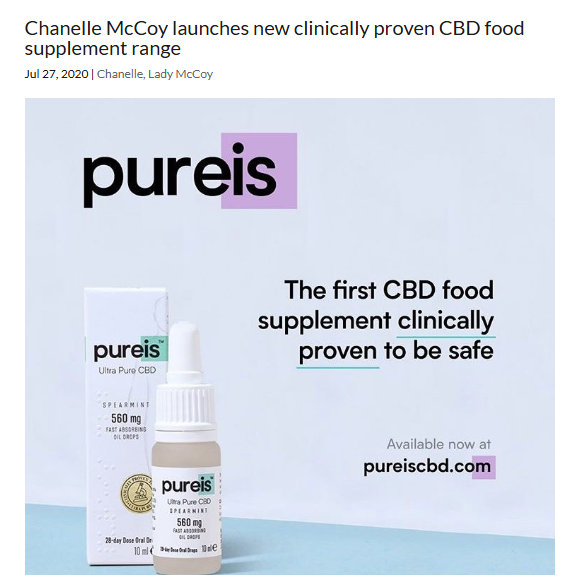
11 January 2021 – The Hemp Hound Agency is established, continuing advisory and regulatory analysis work independently.
19 March 2021 – The FSA updates guidance confirming qualification requirements. This included the statement: “To bring the market into compliance, exceptionally we asked the industry to submit applications for CBD products that were on sale on 13 February 2020”.

7 April 2021 – Public List validations begin. Initial concerns arise regarding products appearing without clear evidence of consumer market presence. Pureis is announced as “the first on the public list”.
To note: Pureis' products were validated on the basis of synthetic CBD being identical to plant derived CBD. However, the Precision Breeding Bill, which would allow for such a distinction, wasn't passed until March 2023.
That issue becomes more significant when viewed against the FSA’s own strategic position on food authenticity.
In its “Food you can trust” strategy, which was published in March 2022, the FSA states that compromising the authenticity of food is a matter of concern and that food crime is taken seriously. Yet, in the case of Pureis, products were validated as “ultra-pure” CBD before Parliament had passed legislation allowing synthetic CBD to be treated as equivalent to plant-derived CBD isolate.
When this was raised with the FSA, it stated that responsibility ultimately rests with companies to ensure products are represented correctly on the CBD Public List.
The problem is not simply that Pureis’ listings do not state that the products are synthetic CBD products. It is also that the list itself is owned and published by the FSA, and is presented to consumers as a trusted source of regulatory guidance.

12 July 2021 – Pureis' lab reports suggest that this is the date where their first products became available to consumers.

3 February 2022 – Concerns intensify as additional companies are validated despite an apparent lack of qualifying pre-13 February 2020 market presence. This includes Brains Bioceuticals, which announced that its products were due for launch after being validated.

April 2022 – Due to overwhelming concerns being expressed by the hemp and CBD industry, The Hemp Hound Agency approached the then Head of Novel Foods at the FSA, Paul Tossell, asking whether the FSA had made a mistake in validating certain applications, or whether contrary information had been supplied to that which was available in the public domain.
Despite evidence being supplied, Mr Tossell dismissed the concerns, suggesting that evidence of wrongdoing should be submitted, as the FSA took misleading the regulator very seriously.
This was followed by an open letter, to which the FSA responded on 26 May 2022.
4 May 2022 – Cannaray’s application is validated, despite its social media platforms showing that it had no physical products for sale until 28 February 2020.

9 May 2022 – The FSA introduces an alignment pathway, allowing lower-quality applications to join more robust dossiers without a formal change to the original guidance.
At this point, in relation to RP840 (Moonrise CBD), I advised that they contact the FSA for an update on their application. The reason was that they may not have been in a concerning position if the FSA were allowing applications for products that did not exist on or before 13 February 2020.
26 May 2022 – Mr Tossell responds to the open letter from The Hemp Hound Agency.
When asked about Pureis, he stated: “We won’t talk about individual cases. To get on the public list, the company must have supplied information that shows they fit the criteria.”

June 2022 – The FSA responds to RP840 and informs them that their application had been rejected in January of that year.
The reasons given were that they had not proven consumer presence on 13 February 2020, and that the extract used to create their products breached the 1mg rule per kilo weight.
1 July 2022 – Charlotte’s Web products are validated, despite those products breaching the 1mg rule by a factor of 195.

At this point, industry unrest was at its most visible, and The Hemp Hound Agency began research into all points of concern.
15 July 2022 – The Hemp Hound Agency submits a public interest disclosure complaint to the FSA regarding its management of the CBD novel foods process.
Initially, that complaint included Parts 1 and 2 of Exposing the Lies, as well as other articles that raised wider concerns.
This led to the FSA’s Head of Complaints, Noel Sykes, making contact and requesting that the complaint be refined.
After complying, the complaint was resubmitted and focused on six elements:
Products validated despite no consumer presence on or before 13 February 2020 (Pureis, Cannaray, Brains Bioceuticals, and others).
Products validated despite breaching the Misuse of Drugs Regulations 2001, Regulation 2, Limb C (1mg rule) (Charlotte’s Web, Savage Cabbage, and others).
Food crimes (validation of synthetic CBD on the basis that it was identical to plant-derived CBD before legislation allowed, and the diminishing of whole-plant authenticity by focusing solely on CBD as a compound).
Monopolies (undeclared academic conflicts of interest within regulatory panels, and the influence of GW Pharmaceuticals over the consumer industry).
The contribution of a named manager within the FSA (specifically Mr Tossell, and his refusal to accept evidence of products being validated despite not qualifying for the novel foods process).
FSA relations with the Association for the Cannabinoid Industry (ACI).
The only part of this complaint that is relevant to the timeline from this point onward concerns Pureis.
30 November 2022 – A complaint meeting was held between The Hemp Hound Agency and the Head of Complaints at the FSA.
There were three key points of interest:
It was stated by the Head of Complaints that “The civil service has a habit of ignoring inconvenient truths” within minutes of the meeting beginning.
Dr James Cooper also attended and appeared intent on rewording the complaint.
It was requested that the complaint be reframed outside of a public interest disclosure due to the potential harm it could cause to named FSA staff.
A further point of interest was that Dr Cooper introduced “on the market” as an alternative to proving consumer sales.
8 December 2022 – The FSA formally accepts my complaint regarding its handling of CBD novel foods.
12 May 2023 – After three emails apologising for delays in processing, the FSA provides a response to The Hemp Hound Agency’s complaint, dismissing all points.
Consumer presence was supplemented by “on the market”, and products identified as breaching the 1mg rule were deemed acceptable based on market presence on or before 13 February 2020.
Direction was given to escalate the matter to Emily Miles, then CEO of the FSA.
26 June 2023 – The complaint was escalated to Ms Miles. The Head of Complaints stated that he would update her on the complaint and escalation material, and that she would make contact thereafter.
5 December 2023 – Due to no contact from Ms Miles, The Hemp Hound Agency launched a series of FOI requests, including one to the FSA requesting all investigation files relating to the complaint.
This led to an email from the Head of Complaints, who apologised for the complaint having been shelved and suggested that this was due to workload pressures.

22 December 2023 – An FOI response from the Home Office confirmed the existence of CBD policy.
When asked to define that policy, the Home Office stated that there was no single document outlining its intent.
When the FSA was asked, it stated that there were over 1,100 documents relating to CBD policy on file, dated between 1 October 2022 and 12 October 2023.
I put it to you that if the CBD novel foods process had been operated transparently, consistently, and in a manner capable of withstanding scrutiny, then the existence of extensive “CBD Policy” activity in the background would likely raise little concern.
However, that is not the situation outlined throughout this article.
Instead, what emerges is a process in which qualifying criteria appear to shift in practice, concerns are repeatedly narrowed procedurally, scrutiny is resisted, and the applications at the centre of those concerns continue to progress regardless.
It is within that context that the existence of over 1,100 CBD policy-related documents inside the Food Standards Agency becomes significant.
Not because policy development is unusual in itself, but because neither the Home Office nor the FSA has clearly explained the overall intent behind that activity, despite its overlap with a process already subject to serious questions regarding consistency and market access.
8 January 2024 – After discovering that the novel foods applications for Pureis and Cannaray were being progressed despite being named in a public interest disclosure complaint, The Hemp Hound Agency submitted a letter of concern to Emily Miles.
In response, she stated: “An application may be linked to some products on the list but equally could be for future products yet to be developed or marketed, as would be the case for any non-CBD novel food.”
That is contrary to all published guidance and does not align with the definition of “on the market”, in that a company cannot be holding food or feed for the purpose of sale if its products were yet to be developed and marketed.
6 March 2024 – A meeting was held between the FSA and The Hemp Hound Agency. In attendance were two FSA directors who had no involvement in CBD novel foods.
A printout of key points of evidence was provided, including Charlotte’s Web lab reports showing that its products breached Misuse of Drugs legislation (1mg rule) by a factor of 195, as well as a lab report from Pureis indicating that it could not have had products available to consumers on or before 13 February 2020.
I was informed by the FSA directors that, regardless of their findings, the ultimate decision on the complaint would rest with Ms Miles.
Of further interest was that I was informed the complaint could not be viewed as a public interest disclosure. This position was relayed by Ms Miles through the interviewing directors, on the basis that I had not worked for the FSA, either directly or under contract.
My position was that the concerns raised extended beyond any personal grievance. They related to consistency of process, equal market access, and confidence in the administration of CBD novel foods itself.
As an industry stakeholder who had advised hundreds of companies on the process, I considered it necessary to bring those concerns to the regulator, even where those concerns related to the regulator itself.
19 March 2024 – The FSA provides all files in relation to the investigation into my complaint regarding its handling of CBD novel foods.
The files showed the following:
An employment agency worker was used to investigate the complaint. That individual was the FSA’s former Head of Resilience. He did not have permission to access personal data, and the Head of Complaints misrepresented him as additional internal resource.
There was a visible attempt to dismiss the complaint.
Mr Tossell was part of the investigation in which he was named. He was informed that no points would be upheld and was allowed to review the final response for “factual inaccuracies”.
The FSA had dismissed similar complaints regarding CBD novel foods. One was dismissed on the basis of being submitted anonymously; however, the complainant had provided an email address and invited further discussion.
Confirmation was provided that all local authorities were asked to catalogue CBD products available to consumers on or before 13 February 2020 and to send that data to BEIS.
Confirmation that the FSA accepted Cannaray into CBD novel foods despite knowing that it had import issues, meaning it had no products until 15 days after the FSA’s deadline.
It was also stated that Pureis products had been validated on the basis of traceability, rather than proof of consumer sales.


To note: the use of traceability in this context raises a further issue regarding rebranding.
In the case of Pureis, the conclusion refers to “slight variability in exact name of products”, while the Cannaray conclusion states that the FSA was “unable to verify if labels using Cannaray branding were used on the invoiced products”.
Taken together with the wider points raised throughout this article, this strongly suggests that the FSA departed from all four key requirements originally presented for qualification into CBD novel foods.
Those contradictions were then carried further through inclusion on the CBD Public List.
Those files were sent to the FSA directors who conducted the escalation interview. They responded by stating that they were unable to accept further evidence, even though their remit at that stage was to determine whether the investigation had been conducted fairly and in good faith, and the files provided strongly suggested otherwise.

23 May 2024 – Emily Miles provides an escalation response that dismisses all points, while suggesting that there was an issue with some products being validated despite breaching Misuse of Drugs legislation.
11 April 2025 – An FOI response was received from the Home Office confirming a connection between Ms Miles and CBD policy. This was escalated to the FSA with a request that the complaint regarding its handling of CBD novel foods be reopened.
The reason for this is that Ms Miles did not mention any potential conflict when providing the final response to the escalated complaint.
The request to reopen the complaint was rejected by the Head of Complaints.

At no point in the first part of the timeline has the FSA actively attempted to explain how Pureis, and others, came to occupy the position they now hold within the CBD novel foods process.
In 2022, when questioned directly about Pureis, Paul Tossell declined to discuss the company specifically, but stated that information must have been supplied showing that the application met the qualification criteria.
In 2024, the FSA then provided information showing that Pureis had been accepted into the process on the basis of traceability, despite variability in naming.
That point is important because it strongly suggests that products branded as “Pureis” did not exist on or before 13 February 2020.
By extension, it also suggests that the FSA allowed for continuity through traceability, despite previously informing the industry that rebranding would create a new product that would not qualify for the CBD novel foods process.
Alongside this were two complaint responses: one involving an employment agency worker who was later found to have been misrepresented within the complaint process, and another issued by the former CEO of the FSA.
Neither directly addressed the position of Pureis, while both dismissed the wider concerns raised.
Between those responses was a further statement from Ms Miles indicating that products on the CBD Public List could relate to products “yet to be developed or marketed.”
That description appears consistent with the situation surrounding Pureis. However, no published guidance reflected such a position at the time.
Equally, if that interpretation existed from the outset, it should have been communicated from the beginning of the CBD novel foods process.
If it emerged later, then it should have been communicated to the wider industry at the earliest opportunity.
The difficulty with the latter position is that it would imply a material change in interpretation after companies had already been excluded from the process under what appeared to be far stricter qualification criteria.
In the context of a static deadline, fixed market entry requirements, and repeated statements that rebranding and future products would not qualify, that would raise further questions surrounding consistency, fairness, and equal market access.
That's why what follows is what really matters
Let me start by saying this: Sometimes, you find more clarity by giving someone the last word...
When the FSA provided investigation files, I knew I would have to wait five years from the point of Pureis submitting its novel foods application before making any meaningful move around disclosure.
I am aware that the timeframe between submission and validation was relatively short. However, for the sake of caution, I chose to wait until 1 February 2026 before taking any further step.
If the FSA provided files showing what it had reviewed to determine Pureis’ market presence in 2020, I would be able to compare that information against what was available in the public domain.
If it refused, then the wording of that refusal might still be of value.
1 February 2026 – The FSA receives an FOI request for all files submitted by Pureis to demonstrate market presence on or before 13 February 2020.
25 February 2026 – The FSA responds to the FOI request, stating that the information is exempt.
This was escalated to Internal Review.
15 April 2026 – The FSA respond to the Internal review admitting that exemptions had not been properly applied, but they still refused the information on the basis that disclosure could be damaging for both the applicant, and the FSA.
An open letter questioning their response was published and sent to the FSA for comment.
22 April 2026 – The FSA responds to the open letter stating that the CBD Public List has been operated “consistently and transparently”, and that all matters have been addressed through prior correspondence and FOI responses.
Are any issues resolved?
The FSA’s position is that the matter has been addressed in full through prior correspondence and FOI responses.
That raises a straightforward question:
Does the information provided actually address the specific concern surrounding the validation of Pureis’ application?
And if it does not, a second question follows:
What exactly does the information address?
All we have is:
Proof of when Pureis launched (27 July 2020)
Proof that its application was the first to be validated
Proof that concerns were raised with the FSA, and not just by The Hemp Hound Agency
Proof that its application was progressed on the basis of traceability, rather than proof of sales
A letter from the former CEO of the FSA stating that some products on the CBD Public List could be for products yet to be developed and marketed, which goes against all published guidance
And proof through published guidance that the industry was not informed that "products on the CBD Public List could be for products yet to be developed and marketed"
As it stands, this is evidence suggesting that the FSA has allowed for rebranding, despite informing the industry that this was not permitted.
It is also evidence that the FSA is operating a two-tier system to the detriment of those who followed its rules.
As for RP840
The FSA has stated that it has erased records of companies rejected from CBD novel foods after four years.
This removes the ability to independently assess whether similar applications were treated consistently.
The question is no longer whether concerns have been raised
The question is whether the available evidence, taken as a whole, would withstand independent scrutiny.
Because if the criteria for entry into the CBD novel foods process were clear, and if those criteria were applied consistently, then the position of Pureis should be straightforward to explain.
At present, it is not.
And in the absence of a clear and evidenced explanation, the issue does not disappear.
It escalates.
Not as a matter of industry frustration, but as a question of regulatory integrity.
This matter could be resolved through the disclosure of the evidence used to validate market presence, alongside a clear explanation of how that evidence meets the criteria set out on 13 February 2020.
Until that point, the position remains unclear, and the concerns remain valid. That is my view based on the evidence presented throughout this article.
You may take a different view and conclude that the Food Standards Agency has, in fact, addressed these matters appropriately.
If so, I invite you to comment.
One final note
In March this year, the Food Standards Agency informed those within the CBD novel foods process that the UK was negotiating a Sanitary and Phytosanitary (SPS) agreement with the EU.
There are many concerns surrounding this, particularly for the hemp and CBD industry, which has now been told that its six-year journey through CBD novel foods may ultimately mean very little if the UK aligns with the EU on food safety matters.
Within those announcements was an indication that not all companies would be affected equally.
The FSA stated in an open board meeting that any SPS agreement could create “winners and losers” within CBD novel foods.
Unfortunately, it would appear that Pureis and Cannaray are two of the three potential winners.
What makes this difficult to dismiss as a simple disagreement is that the concerns surrounding those applications were not raised once and abandoned.
At several stages, there remained an expectation that the matter would be properly examined.
When evidence was first submitted, when a formal complaint was accepted, when escalation meetings were held, and even when supporting documentation was placed directly before senior figures within the FSA, there was still an assumption that clear contradictions would eventually lead to meaningful scrutiny.
Instead, the opposite occurred. The complaints process stalled, concerns were reframed, and the applications at the centre of those concerns continued to progress.
For more information on The Hemp Hound Agency, email: cefyn.jones@hemphound.co.uk


Comments